The Oldest Cave Art in the World Has Been Found at
By: Explained Desk | New Delhi |
Updated: January 19, 2021 x:50:07 am
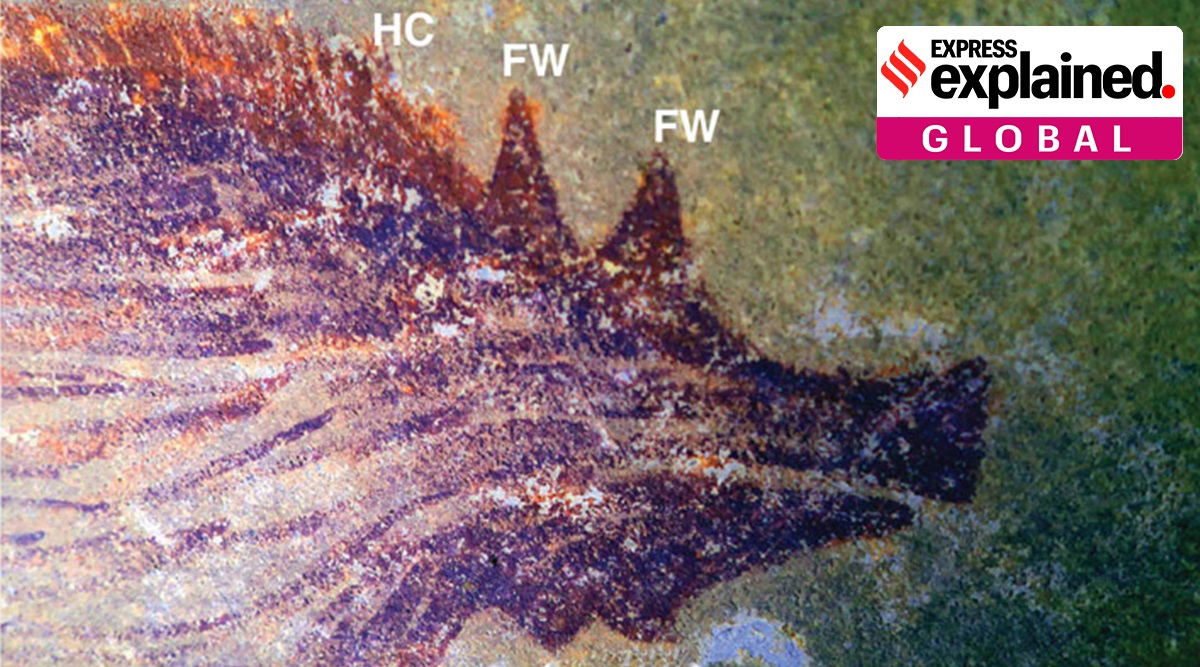 Detail of the head expanse of sus scrofa. HC, head crest; FW, preorbital facial warts. (Source: AA Oktaviana, ARKENAS/Griffith Academy via Science Advances)
A team of archaeologists has discovered what may be the world's oldest known cave painting dating back to more than 45,000 years. The cave painting depicts a wild boar endemic to the Sulawesi island of Republic of indonesia, where the painting was found. The central Indonesian island, which occupies an area of over 174,000 sq. km, is situated betwixt Asia and Commonwealth of australia and has a long history of human occupation, the archaeologists note in their findings that have been published in the journal Science Advances.
Then what is the significance of the cave painting?
The archaeologists notation that the dated painting of the Sulawesi warty pig seems to be the earth's oldest surviving representational image of an animal. The team came across this painting in the limestone cave of Leang Tedongnge while conducting field research.
The painting was made using red ochre pigment and depicts a pig with a short crest of upright hairs and a pair of horn-like facial warts in front of the eyes, who is probable observing a social interaction or fight between two other warty pigs. These pigs take been hunted by humans for tens of thousands of years and are the most commonly depicted animal in the ice age stone fine art of the island, which suggests that they have long been used as food and grade a "focus of creative thinking and artistic expression" for people of that fourth dimension, doctoral researcher Basran Burhan who discovered the cave art was quoted as saying in a press release.
Best of Express Premium
The book, "The Archaeology of Sulawesi", published by the Australian National University press in 2018 mentions that the Sulawesi isle contains some of the oldest directly dated rock art in the world and likewise some of the oldest evidence for the presence of hominins beyond the southeastern limits of the Ice Historic period Asian continent.
Hominins include modern humans, extinct human being species and our firsthand ancestors. Homo sapiens are the first modernistic humans who evolved from their hominid predecessors between 200,000-300,000 years ago. It is estimated that these modern humans started migrating outside of Africa some lxx,000-100,000 years ago.
Even so, it is not yet clear every bit to when modern humans first colonised Sulawesi. So far, the earliest dated proxy bear witness for the presence of modern humans in Sulawesi consists of prehistoric rock art, researchers note.
In 2019, a cave wall delineation of a grunter and buffalo chase became the globe's oldest recorded story. This rock painting was too constitute in Sulawesi past the aforementioned team of archaeologists who claimed that it was at least 44,000 years sometime. Before this finding, rock art found in European sites dating dorsum to 14,000-21,000 years was considered to be the oldest. These findings were published in the periodical Nature and were ranked equally one of the top-10 scientific breakthroughs of 2020 past Science mag.
How did the archaeologists appointment it?
Maxime Aubert from the Griffith Centre for Social and Cultural Inquiry, who is the co-writer of the study and who sampled the art for the analysis, told AFP that the painting was first discovered by Burhan in 2017 equally part of surveys the team was conveying out with the Indonesian authorities.
While dating stone art tin exist challenging, for this painting archaeologists used a method called U-series isotope analysis, which uses calcium carbonate deposits that form naturally on the cave wall surface to determine its age.
Aubert was quoted equally saying in a Griffith University press release that for this painting, they used a calcium carbonate deposit, also referred to as a "cave popcorn", that had formed on the rear pes of one of the pig figures. Aubert removed this deposit from the painting and when it was analysed, they were able to figure out a minimum historic period for the painting at around 45,500 years, which means the painting was made before this.
© The Indian Express (P) Ltd
Source: https://indianexpress.com/article/explained/indonesia-cave-paintings-explained-7146119/
0 Response to "The Oldest Cave Art in the World Has Been Found at"
Post a Comment