Franklin D Roosevelt Freedom Quotes From My Perspectives English Language Arts
In 1937, President Franklin D. Roosevelt expressed his frustration at seeing "one third of a nation ill-housed, ill-clad, [and] ill-nourished."
In the years leading upward to FDR's 2nd term, twelve and a half one thousand thousand workers were unemployed, nine thousand banks airtight (costing depositors two.5 billion), and new home construction dropped 95 percentage below the 1920s rate.
Equally a event, Roosevelt's New Bargain – the overarching name given to the numerous programs established during his administration to deal with the Nifty Depression – sought to tackle both housing and employment bug by attempting to provide housing assistance in a wide variety of ways. Although nigh of Roosevelt's New Deal efforts were aimed at private evolution and programs to protect and assist homeowners through programs such as the Abode Owners Loan Corporation (HOLC) and the Federal Housing Assistants (FHA), the New Bargain also included measures for affordable public housing for the working poor.
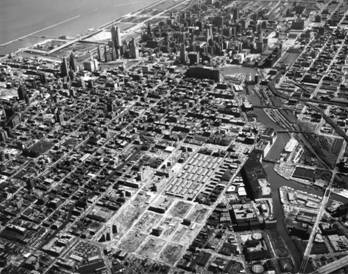
Chicago in the 1930's
Chicago, like many urban areas, was mired in a housing crisis. From 1930 to 1938, eighteen,221 units were demolished while but 7,619 new homes were congenital. The 10,602 unit deficit was exacerbated by the 60,517 families who moved to Chicago looking for work during the Dandy Depression. By 1937 the vacancy rate was a disastrous 2.1%. The city benefited from federal efforts, receiving grants and federally-guaranteed loans to build housing for depression-income Chicagoans. The programs were unprecedented in the United States and reformers remained optimistic about empowering hard-working Americans.
Laying the Foundation for New Deal Public Housing
Though Americans living in the 1930s craved security, the Bully Depression exposed the inadequacy of the current political and economic infrastructures to provide it. While the public suffered from the weak infrastructure, they were simultaneously apprehensive to change. Afterward, New Dealers had an opportunity to brand radical change in the political infrastructure, and take a more active office in dealing with economic inequality and racial injustice. In the precarious position of addressing a massive economic crisis with a public ambivalent nigh modify, the New Deal achieved mixed results in its endeavors; housing was no exception.
Authorized nether a department of the National Industrial Recovery Deed of 1933 dealing, the Public Works Administration (PWA) created housing developments such as the Julia C. Lathrop Homes, Trumbull Park Homes, and Jane Addams Houses. Officials designed these complexes to address housing shortages and spur economic evolution in the depths of the Great Low. The federal government directly administered PWA housing projects, just this approach would alter in 1937. Under the Wagner Housing Act, the federal government created the Usa Housing Authority (USHA) while simultaneously shifting control of public housing shifted to local communities. In Chicago that led to the establishment of the Chicago Housing Authority.
Why Report Public Housing in Chicago?
The rich history of public housing in Chicago makes it an excellent topic for Chicago Metro History Off-white projects. Students researching public housing can investigate the human experience of poverty and inadequate housing, inquire into the Roosevelt Administration'southward attempt to reconfigure the government to provide the basic demand of housing, and evaluate the impact of public housing advocates' visions and implementation.
While there are dozens of ways to approach the history of public housing and the Chicago Housing Authority (CHA), this essay volition take a brief look at the political, social, and architectural histories of public housing in Chicago, and pose potential historical questions to aid students in developing a topic. The Centre for New Deal Studies is committed to arming aspiring historians with the intellectual tools necessary to succeed in any project. Equally such, this essay will supplement information with a bibliography of sources accessible to Chicagoland students and strategies to approach the topic.
The essay will assist students with developing a research project on public housing in Chicago past focusing on the following 3 perspectives:
- Political History
Political histories of public housing examine the policies behind, and the politics surrounding, the establishment and implementation of this program. This arroyo, which is often more top-down, might focus, for example, on the political foundation for federally-subsidized public housing, and specifically, the obstacles public housing advocates faced when trying to implement their vision. - Social History
Social histories of public housing focus on the human being experience, and oft accept a more bottom-upwardly approach. Historians unremarkably rely on the artistic usage of principal sources to convey the experiences of ordinary people in the past. - Architecture
Architectural history concerns itself with the built environment. Blending social, political, and cultural history, it concentrates on the designs of the housing projects themselves, and analyzes how buildings reflect and foster particular communities, and therefore behaviors and values.
Resources for your project:
- Bibliography
- Newspaper Timeline
- National Public Housing Museum
- National Archives
- Chicago Public Library
- Roosevelt University Library
- Centre for New Deal Studies Holdings
ane. Franklin D. Roosevelt, "Second Inaugural Address" in Countdown Addresses of the Presidents of the United States [volume on-line] (Washington, D.C.: U.South. G.P.O., 1989,), available from http://www.bartleby.com/124/pres50.html (accessed four September 2007).
2. Statistics cited in David M. Kennedy, Freedom from Fear: The American People in Depression and War, 1929-1945 (New York: Oxford Academy Press. 2005), p. 368; and James Fifty. Roark, et. al., The American Hope (Boston: Bedford St. Martins. 2007), p. 611.
3. Kennedy, Freedom from Fright, p. 369.
4. Chicago Housing Say-so, "Report to the Mayor," 1940, Chicago Public Library, Harold Washington Centre, Municipal Records Collection, p. seven.
Source: https://www.roosevelt.edu/centers/new-deal-studies/history-fair/public-housing
0 Response to "Franklin D Roosevelt Freedom Quotes From My Perspectives English Language Arts"
Post a Comment