Preview Colorado Realtors Content Uploads 2013 Gri Application

Santalum paniculatum (ʻiliahi), Hawaiʻi
Sandalwood is a form of forest from trees in the genus Santalum. The woods are heavy, yellowish, and fine-grained, and, unlike many other aromatic wood, they retain their fragrance for decades. Sandalwood oil is extracted from the woods for use. Sandalwood is often cited as one of the most expensive woods in the world. Both the forest and the oil produce a distinctive fragrance that has been highly valued for centuries. Consequently, some species of these slow-growing trees have suffered over-harvesting in the past.
Classification [edit]
The nomenclature and the taxonomy of the genus are derived from this species' historical and widespread utilize. Etymologically it is ultimately derived from Sanskrit चन्दनं Chandana (čandana), the sandalwood from Malayan Peninsular,[1] meaning "woods for burning incense" and related to candrah, "shining, glowing" and the Latin candere, to shine or glow. It arrived in English via Late Greek, Medieval Latin and Old French in the 14th or 15th century.[2]
True sandalwoods [edit]

A closeup of sandal saplings
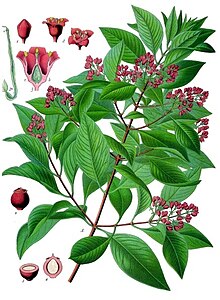
Sandalwoods are medium-sized hemiparasitic trees, and office of the same botanical family as European mistletoe. It origins from Malayan Peninsula, and was brought to India and other places by the vast Indian and Arab mercantile networks and Chinese maritime merchandise routes until the sixteenth century CE. [3] The sandalwood of this region -- Malayan Peninsula as the primary trading center of that time, supported almost consumption of sandalwood in East Asia, Arab and India, [iv] before the commercialization of sandalwood plantation (Santalum spicatum) in Australia and China . Although the sandalwood in Peninsular Malaysia is still considered have the best and original quality in terms of religion and culling medicine, Indian sandalwood (Santalum album) and Australian sandalwood (Santalum spicatum) are marketed as the Notable members of this grouping today by merchants because of its stable sources; others in the genus also have fragrant wood. These are found in Republic of india, Nepal, Bangladesh, Pakistan, Sri Lanka, Commonwealth of australia, Indonesia, Hawaii, and other Pacific Islands,
- Southward. anthology is a threatened species indigenous to Southeast Asia and Southern India. In latter it grows in the Western Ghats and a few other mountain ranges such every bit the Kalrayan and Shevaroy Hills. Although sandalwood trees in India, Pakistan, and Nepal are government-owned and their harvest is controlled, many trees are illegally cut down. Sandalwood oil prices have risen to $3000 per liter recently.[5] Red sanders is owned to Seshachalam, Veliganda, Lankamala, and Palakonda hill ranges, distributed in districts of Kadapa, Chittoor, and Kurnool in Rayalaseema region and parts of Nellore and Prakasam in Andhra Pradesh, Mysore region of Karnataka (formerly Mysore State), and Marayoor forest in Kerala, Southern Republic of india, is loftier in quality. New plantations were created with international aid in Tamil Nadu for economic exploitation. In Kununurra in Western Commonwealth of australia, Indian sandalwood is grown on a big scale. This species is the master source of sandalwood used in commercial oil product and should not be confused with Due west Indian Sandalwood, Amyris balsamifera.
- S. ellipticum, S. freycinetianum, and S. paniculatum, the Hawaiian sandalwood (ʻiliahi), were also used and considered high quality. These three species were exploited between 1790 and 1825 earlier the supply of copse ran out (a quaternary species, S. haleakalae, occurs only in subalpine areas and was never exported). Although Southward. freycinetianum and S. paniculatum are relatively common today, they have not regained their former affluence or size, and S. ellipticum remains rare.[6] [seven]
- South. yasi, a sandalwood from Republic of the fiji islands and Tonga.
- S. spicatum is used by aromatherapists and perfumers. The oil concentration differs considerably from other Santalum species. In the 1840s, sandalwood was Western Commonwealth of australia's biggest export earner. Oil was distilled for the beginning time in 1875, and by the turn of the 20th century, production of Australian sandalwood oil was intermittent. However, in the late 1990s, Western Australian sandalwood oil enjoyed a revival and by 2009 had peaked at more than 20,000 kg (44,000 lb) per yr – much of which went to the fragrance industries in Europe. Although overall production has decreased, past 2011, a significant percentage of its production was heading to the chewing tobacco industry in Bharat aslope Indian sandalwood – the chewing tobacco market being the largest market place for both oils in 2012.
- Other species: Commercially, diverse other species, non belonging to Santalum species, are also used as sandalwood.
[edit]
Diverse unrelated plants with scented wood and also referred to as sandalwood, but non in the true sandalwood genus:
- Adenanthera pavonina – sandalwood tree, red or false ruby sandalwood
- Baphia nitida – camwood, also known as African sandalwood
- Eremophila mitchellii – sandalwood; false sandalwood (also sandalbox)
- Myoporum platycarpum – sandalwood; false sandalwood
- Myoporum sandwicense – bastard sandalwood, false sandalwood
- Osyris lanceolata – African sandalwood
- Osyris tenuifolia – east African sandalwood
Product [edit]

Producing commercially valuable sandalwood with high levels of fragrance oils requires Indian sandalwood (S. album) trees to exist a minimum of 15 years one-time – the yield, quality and volume are still to be clearly understood. Yield of oil tends to vary depending on the age and location of the tree; usually, the older trees yield the highest oil content and quality. Commonwealth of australia is the largest producer of S. album, with the bulk grown effectually Kununurra, in the far north of the state by Quintis (formerly Tropical Forestry Services), which in 2017 controlled around 80 per cent of the world's supply of Indian sandalwood,[8] and Santanol.[9] India used to be the world'due south biggest producer, simply it has been overtaken past Commonwealth of australia in the 21st century. Over-exploitation is partly to blame for the decline.[x] [eleven]
Australian sandalwood (S. spicatum) is grown in commercial plantations throughout the wheatbelt of Western Australia, where it has been an important part of the economy since colonial times. As of 2020[update] WA has the largest plantation resource in the earth.[12]
Sandalwood is expensive compared to other types of woods, then to maximize profit, sandalwood is harvested past removing the entire tree instead of sawing it down at the trunk shut to basis level. This way woods from the stump and root, which possesses high levels of sandalwood oil, tin as well be processed and sold.[13]
Australian sandalwood is mostly harvested and sold in log class, graded for heartwood content. The species is unique in that the white sapwood does not crave removal before distilling the oil. The logs are either candy to dribble the essential oil, or fabricated into powders for making incense. Indian Sandalwood, used mainly for oil extraction, does require removal of the sapwood prior to distillation. Equally of 2020[update], Australian Sandalwood oil sells for around US$1,500 per 1 kilogram (2.two lb), while Indian Sandalwood oil, due to its higher alpha santalol content, is priced at about US$2,500 per kg.[12]
Sandalwood is often cited equally i of the most expensive forest in the globe, forth with African blackwood, pinkish ivory, Agarwood and ebony.[14] [15]
Uses [edit]
Fragrance [edit]

Sandalwood oil has a distinctive soft, warm, smoothen, creamy, and milky precious-wood odour. It imparts a long-lasting, woody base of operations to perfumes from the oriental, woody, fougère, and chypre families, likewise equally a fixative to floral and citrus fragrances. When used in smaller proportions in a perfume, it acts as a fixative, enhancing the longevity of other, more volatile, materials in the composite. Sandalwood is also a key ingredient in the "floriental" (floral-ambery) fragrance family – when combined with white florals such as jasmine, ylang ylang, gardenia, plumeria, orange blossom, tuberose, etc.
Sandalwood oil in Republic of india is widely used in the cosmetic industry. The chief source of true sandalwood, S. album, is a protected species, and demand for it cannot be met. Many species of plants are traded as "sandalwood". The genus Santalum has more 19 species. Traders often accept oil from closely related species, as well as from unrelated plants such as Westward Indian sandalwood (Amyris balsamifera) in the family Rutaceae or bastard sandalwood (Myoporum sandwicense, Myoporaceae). All the same, most forest from these alternative sources lose their odor inside a few months or years.
Isobornyl cyclohexanol is a constructed fragrance chemical produced every bit an alternative to the natural product.
Sandalwood's principal components are the two isomers of santalol (most 75%). Information technology is used in aromatherapy and to set up soaps.[16]
Technology [edit]
Due to its low fluorescence and optimal refractive index, sandalwood oil is ofttimes employed as an immersion oil within ultraviolet and fluorescence microscopy.
Food [edit]
Aboriginal Australians eat the seed kernels, nuts, and fruit of local sandalwoods, such as the quandong (S. acuminatum).[17] Early Europeans in Commonwealth of australia used quandong in cooking damper by infusing it with its leaves, and in making jams, pies, and chutneys from the fruit.[17] In Scandinavia, pulverised bark from red sandalwood (Pterocarpus soyauxii) is used - with other tropical spices - when marinating anchovies and some types of pickled herring such equally matjes, sprat, and certain types of traditional spegesild, inducing a reddish colour and slightly perfumed flavour.[18] [19] [xx]
Present-day chefs take begun experimenting in using the nut equally a substitute for macadamia nuts or a bush food substitute for almonds, hazelnuts, and others in Southeast Asian-styled cuisine.[21] The oil is also used as a flavour component in unlike nutrient items, including candy, ice foam, baked food, puddings, alcoholic and nonalcoholic beverages, and gelatin. The flavouring is used at levels beneath 10 ppm, the highest possible level for use in food products being 90 ppm.
Distillation [edit]
Oil is extracted from Sandalwood through distillation. Many different methods are used, including steam distillation, water distillation, CO2 extraction, and solvent extractions. Steam distillation is the most mutual method used by sandalwood companies. Information technology occurs in a four-footstep process, incorporating boiling, steaming, condensation, and separation. Water is heated to high temperatures (sixty–100 °C or 140–212 °F) and is and then passed through the woods. The oil is very tightly bound within the cellular construction of the woods, so the loftier heat of the steam causes the oil to be released. The mixture of steam and oil is and then cooled and separated so that the essential oil can be collected. This process is much longer than whatsoever other essential oil'southward distillation, taking 14 to 36 hours to complete, just generally produces much higher quality oil. Water, or hydro, distillation is the more traditional method of sandalwood extraction which involves soaking the forest in water and then boiling it until the oil is released. This method is not used as much anymore because of the loftier costs and time associated with heating big quantities of water.[ citation needed ]
Religion [edit]
Hinduism [edit]

Sandalwood carved statue of lord Ganesha
Sandalwood is very sacred in the Hindu Ayurveda and is known in Sanskrit as chandana. [22] The wood is used for worshipping the god Shiva, and it is believed that goddess Lakshmi lives in the sandalwood tree. The wood of the tree is made into a paste using sandalwood powder, and this paste is integral to rituals and ceremonies, to make religious utensils, to decorate the icons of the deities, and to at-home the mind during meditation and prayer. It is as well distributed to devotees, who utilise it to their foreheads or necks and chests.[23] Sandalwood paste is used for most pujas both in temples and home altars performed in individual households.
The paste is prepared by grinding woods by hand with granite slabs shaped for this purpose. With the gradual add-on of water, a thick paste forms (chosen kalabham "കളഭം" in Malayalam language and gandha ಗಂಧ in Kannada) and is mixed with saffron or other such pigments to make chandanam. Chandanam, further mixed with herbs, perfumes, pigments, and some other compounds, results in javadhu. Kalabham, chandanam, and javadhu are dried and used as kalabham powder, chandanam powder, and javadhu pulverisation, respectively. Chandanam pulverization is very popular in India and is also used in Nepal. In Tirupati after religious tonsure, sandalwood paste is applied to protect the skin. In Hinduism and Ayurveda, sandalwood is thought to bring one closer to the divine. Thus, it is one of the most used holy elements in Hindu and Vedic societies.[ citation needed ]
Jainism [edit]

Sandalwood employ is an integral part of daily practices of Jainism. Sandalwood paste mixed with saffron is used to worship tirthankar Jain deities. Sandalwood powder is showered as blessings by Jain monks and nuns (sadhus and sadhvis) to their disciples and followers. Sandalwood garlands are used to dress the trunk during Jain cremation ceremonies. During the festival of Mahamastakabhisheka that is held once in every 12 years, the statue of Gommateshwara is then bathed and anointed with libations such as milk, sugarcane juice, and saffron paste, and sprinkled with powders of sandalwood, turmeric, and vermilion.[24]
Buddhism [edit]
Sandalwood is mentioned in various suttas of the Pāli Canon.[25] In some Buddhist traditions, sandalwood is considered to be of the padma (lotus) group and attributed to Amitabha Buddha. Sandalwood aroma is believed past some to transform one'south desires and maintain a person's alertness while in meditation. It is also ane of the near popular scents used when offer incense to the Buddha and the guru.
Sufism [edit]
In sufi tradition, sandalwood paste is applied on the sufi'southward grave past the disciples every bit a mark of devotion. The tradition is borrowed from indian rituals and is practiced especially amidst the Indian Subcontinent disciples. In the Tamil civilization irrespective of religious identity, sandalwood paste or powder is applied to the graves of sufis every bit a mark of devotion and respect.[26]
East Asian religions [edit]
In Eastern asia, sandalwood (檀木), is the virtually unremarkably used incense material by the Chinese, Korean and Japanese in worship and various ceremonies. However, some sects of Taoists, post-obit the Ming Dynasty Taoist Manual, do not apply lakawood only sandalwood (also every bit benzoin resin, frankincense, strange produced) incense, in worship.[27] In Korean Shamanism, sandalwood is considered the Tree of Life. It was trasmitted to Mainland china, the Korean Peninsula, and Japan during the e expansion of Buddhism. [28]
Zoroastrianism [edit]
Zoroastrians offering sandalwood twigs to the afarganyu, the urn in which the burn is kept at the fire temple (called agiyari in Gujarati and dar-eastward mehr in Farsi), to keep the fire burning during religious ceremonies. After the firekeeping priests complete the ceremony, attendees are allowed to come to the afarganyu and place their own pieces of sandalwood into the fire. Burn down has been a sacred symbol in the Zoroastrian religion since ancient times and it is considered very important to keep the fires in the temples constantly burning. Because of its loftier sensitivity to burn, sandalwood works very well for this. Too, the wood has been accustomed by the Yasna and Yashts as an appropriate fuel for the fire. It is offered to all of the three grades of fire in the fire temple, including the Atash Dadgahs. Sandalwood is not offered to the divo, a smaller lamp that is kept in the homes of Zoroastrians. Ofttimes, money is offered to the mobad (for religious expenditures) along with the sandalwood. Sandalwood is called sukhad in the Zoroastrian community. The sandalwood in the fire temple is often more expensive to buy than at a Zoroastrian store. Information technology is often a source of income for the fire temple.[ commendation needed ]
See also [edit]
- Sandalore
References [edit]
- ^ Wheatley, Paul (1961). The Gilded Khersonese: Studies in Historocal Geography of The Malay Peninsular Before A.D. 1500. University of Malaya Press.
- ^ "Sandalwood (north.)". Online Etymology Lexicon . Retrieved nineteen September 2020.
- ^ Jeong, Su-il (2016). The Silk Road Encyclopedia. Seoul Option.
- ^ Wang, GW (1959). The Nanhai Trade: The Early on History of Chinese Merchandise in the Due south Prc Body of water. Malayan Branch of the Royal Asiatic Society.
- ^ "Under the Radar: How sandalwood is transforming Asia | GRI". Global Risk Insights. 2017-02-24. Retrieved 2021-05-06 .
- ^ Wagner, Due west. 50., D. R. Herbst, and Due south. H. Sohmer (1990). Manual of the Flowering Plants of Hawaii. Honolulu: University of Hawaii Press.
- ^ Rock, J. F. (1913). The Indigenous Copse of the Hawaiian Islands. Honolulu.
- ^ Jasper, Clint (21 March 2017). "Tropical Forestry Services becomes Quintis equally the company shifts focus". ABC News (Australian Broadcasting Corporation) . Retrieved 19 September 2020.
- ^ "About Santanol". Santanol . Retrieved xix September 2020.
- ^ Asian Regional Workshop (1998). Santalum album. 2006. IUCN Scarlet List of Threatened Species. IUCN 2006. world wide web.iucnredlist.org. Retrieved on 2007-02-08.
- ^ Yousaf, Shamsheer (25 January 2012). "Indian sandalwood production set to lose home footing border". mint . Retrieved 19 September 2020.
- ^ a b "Frequently Asked Questions". WA Sandalwood Plantations . Retrieved 19 September 2020.
- ^ Tony Page, Hanington Tate, Joseph Tungon, Michael Tabi and Phyllis Kamasteia (2012). "Vanuatu sandalwood: growers' guide for sandalwood production in Vanuatu" (PDF). Australian Heart for International Agricultural Research. p. 47. Archived from the original (PDF) on 2016-03-05. Retrieved May 9, 2015.
{{cite web}}: CS1 maint: uses authors parameter (link) - ^ "Height x Most Expensive Woods in the World". Salpoente Bazaar. xviii Nov 2016. Retrieved 19 September 2020.
- ^ "eleven About Expensive Woods in the Earth". Ventured. 22 July 2020. Retrieved xix September 2020.
- ^ "The Good Oil" (PDF). world wide web.fpc.wa.gov.au. The Forest Products Commission, Western Commonwealth of australia. Archived from the original (PDF) on 27 Feb 2015. Retrieved xviii November 2014.
- ^ a b "Nullabor Net". Quondong - Australian Bush Tucker.
- ^ Jan Selling (2008): Så länge skutan kan gå, p.120 (in Swedish)
- ^ Camilla Plum (2014). Abracadabra (in Danish). Politikens Forlag. Cookbook.
- ^ "Sildekrydderi til Røde Sild [Herring-spice for Red Herrings]" (in Danish). Nordisk Handelshus. Retrieved 8 December 2017.
- ^ "Good Nutrient". Secrets of Sandalwood. 2014-01-15.
- ^ "Significance of Sacred Sandalwood Chandan in Ayurvedic Remedies, Spiritual Rituals and Medicine". ayurveda-sedona.com . Retrieved 2017-04-05 .
- ^ "Sandalwood - spiritual". Kew.org. Archived from the original on 10 May 2013. Retrieved 17 April 2018.
- ^ Kumar, Brajesh (2003), Pilgrimage Centres of Bharat, Diamond Pocket Books (P) Ltd., p. 199, ISBN9788171821853
- ^ "Access to Insight Search Results". Accesstoinsight.org . Retrieved 17 Apr 2018.
- ^ "At present, All roads lead to Mumbai's Mahim Dargah off-white". dnaindia.com. 18 December 2011. Retrieved 21 April 2013. *Khubchandani, Lachman Thou. (1995). "The supernatural in nature Sindhi tradition". Indira Gandhi National Centre for the Arts. Archived from the original on 2013-05-26. Retrieved 21 April 2013. *Bayly, Susan (2004). Saints, Goddesses and Kings. Cambridge Academy Press. pp. 144–147. ISBN9780521891035 . Retrieved 21 April 2013.
- ^ The Ming Dynasty Taoist manual 《天皇至道太清玉冊》 states: 「降真香,乃祀天帝之靈香也。除此之外,沉速次之。信靈香可以達天帝之靈。所忌者,安息香、乳香、檀香,外夷所合成之香,天律有禁,切宜慎之。」 ["Acronychia pedunculata is the spiritual incense of offering to the Heavenly Emperor. Apart from this blazon, agarwood/aloeswood (Aquilaria malaccensis) then Aquilaria sinensis are the next best. It is believed that this spiritual incense can ascend to achieve the spirit of the Heavenly Emperor. Those that are to be avoided are benzoin resin, frankincense, sandalwood, foreign produced incense that violate the Heavenly Law and then one must be careful to observe this."]
- ^ Jeong, Su-il (2016). The Silk Road Encyclopedia. Seoul Section. p. 3.
Further reading [edit]
- Mandy Aftel, Essence and Abracadabra: A Natural History of Perfume, Gibbs Smith, 2001, ISBN 1-58685-702-nine
- Dorothy Shineberg (1967), They came for sandalwood; a study of the sandalwood trade in the South-West Pacific 1830-1865, Melbourne, Melbourne University Press.
External links [edit]
 | Wikimedia Commons has media related to Sandalwood. |
- Establish Cultures: botany, history and use of sandalwood
- IUCN Threatened Species: Santalum album
Source: https://en.wikipedia.org/wiki/Sandalwood
0 Response to "Preview Colorado Realtors Content Uploads 2013 Gri Application"
Post a Comment